
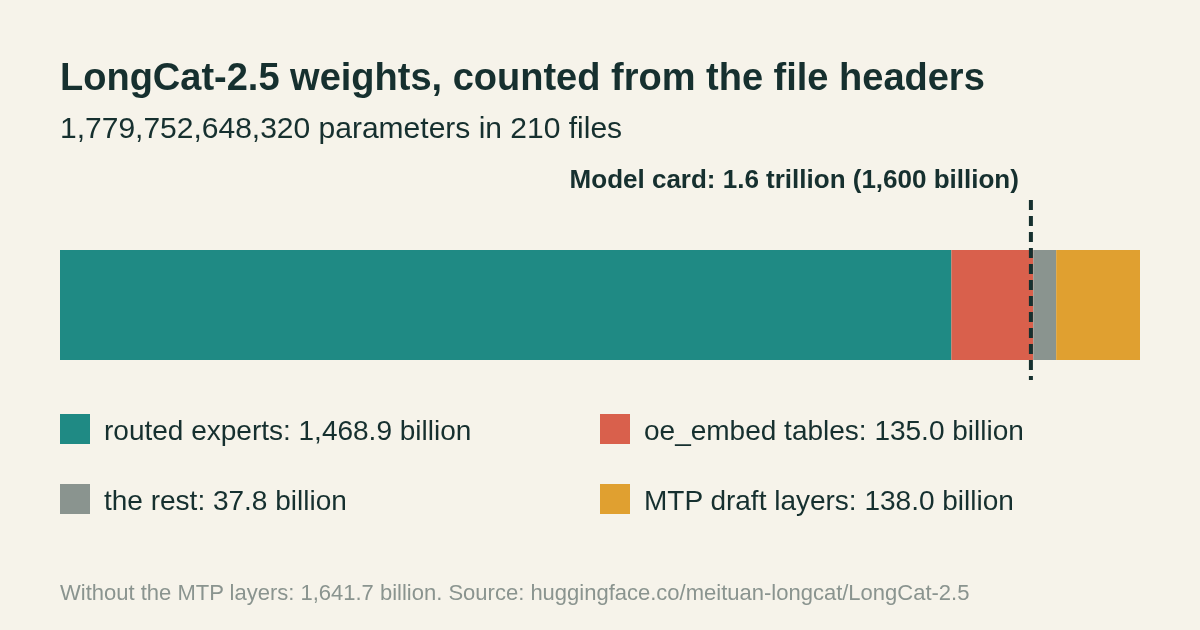
LongCat-2.5 is an open-weight, multimodal mixture-of-experts model from Meituan, built for long agentic coding jobs. The weights sit on Hugging Face under the MIT licence with no gate, and the model card says 1.6 trillion parameters in total and about 48 billion active per token. The LongCat-2.5 weights themselves add up to 1,779,752,648,320 parameters, which is 1.78 trillion, and they take 3,562 GB on disk.
I read the repository on 17 November 2026 at 10:32 UTC. I summed the header of every weight file, weighed the separate 4-bit repository, timed a download and counted the asterisks in the benchmark table. My verdict: the extra 180 billion parameters are real and the card does not itemise them, the 4-bit repo is still 1,336 GB, which is 56 cards of 24 GB, and the asterisks hide less than I expected.
What do the LongCat-2.5 weights add up to?
The Hugging Face API says the repo was created on 4 November 2026. Its safetensors field says 1,778,523,785,600 BF16 parameters and 1,228,862,720 in F32, total 1,779,752,648,320.
One field is not a measurement, so I read the header of each of the 210 weight files with a range request, and summed the shapes. Same total. Then I grouped by name:
- Routed experts: 1,468.9 billion, 82.5% of everything. The config file says 768 routed experts per layer, 12 picked per token, 38 layers.
- MTP module: 138.0 billion of draft heads. 135.0 billion is a near-copy of the main
oe_embedtables, 2.4 billion an embedding, 0.556 billion the layer itself. The config asks for three layers; the checkpoint holds one MTP layer. - Tables named
oe_embedin the main model: 135.0 billion. - Everything else, meaning attention, shared feed-forward, vision and the two big embeddings: 37.8 billion.
The card does not say what its 1.6 trillion counts. Take out the MTP module and 1,641.7 billion are left, which rounds to 1.6 trillion. Take out the oe_embed tables as well and 1,506.7 billion remain. The first reading is the likely one, but it is my reading. The serving recipe starts its servers with MTP on, but the loader in the branch the card points to takes the draft heads’ embeddings from the main model and skips the .mtp. names. About 0.56 billion of the 138 is loaded for drafting; the other 137.5 billion, 275 GB of the 4-bit repo, is read off disk with every shard and dropped, never loaded onto the card.
The vision side is cheap. The card says it builds on LongCat-Next, a March 2026 paper that turns images into discrete tokens, and the config shows the price: a quantiser of 8 codebooks with 16,384 entries each and a vision tower of 3.12 billion parameters. That is 0.18% of the total. “Native multimodal” costs almost nothing in weights.
How many 24 GB cards do the LongCat-2.5 weights need?
On 16 November I wrote about a 145-billion-parameter model that fits a 24 GB card if you add the RAM. This post counts 24 GB as 24,000,000,000 bytes, while that one counted 24 GiB; on a 24 GiB card the counts below become 139 in BF16 and 52 in 4-bit.
I summed the file sizes the API lists. The BF16 repo has 210 files totalling 3,561,974,336,256 bytes: 3,562 GB, or 3,317 GiB. Divided by 24 GB, that is 148.4 cards, so 149. There is also a W4A4 repo, the 4-bit build, with 210 weight files totalling 1,336,010,166,464 bytes. That is 1,336 GB and 56 cards.
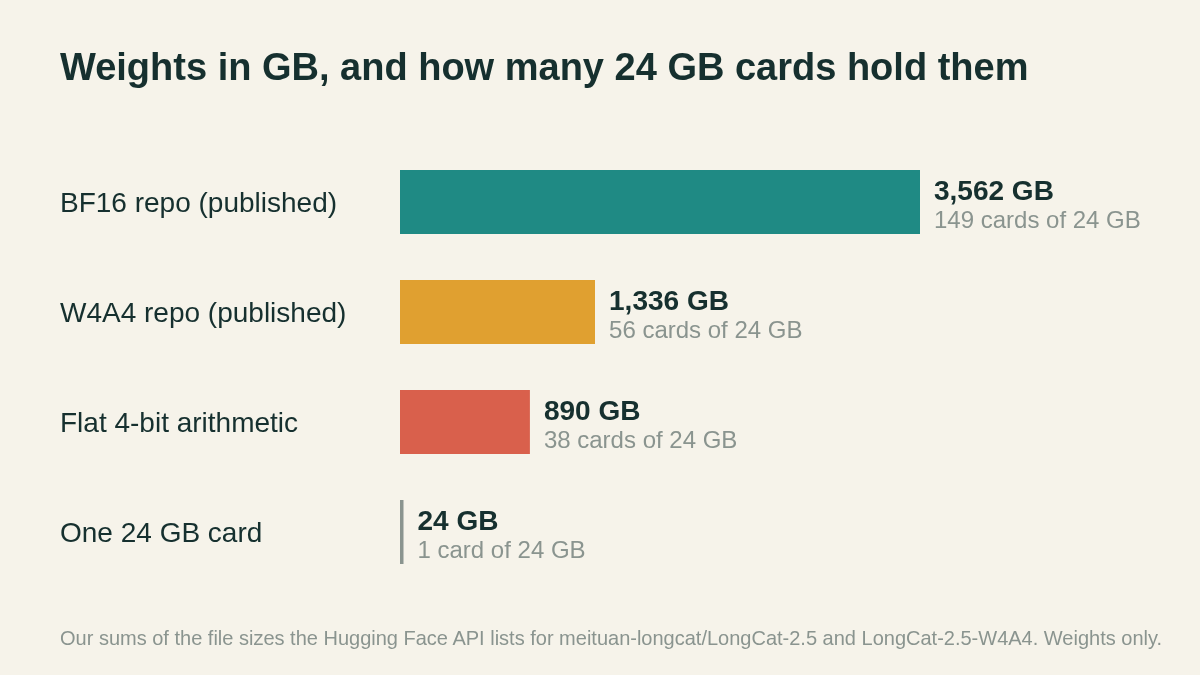
The guess was 1,779.75 billion parameters at half a byte each, 890 GB and 38 cards. The real file is 1.50 times that. The reason is in its metadata: 183,609,851,904 int32 values, which I multiplied by 8 and got 1,468,878,815,232, exactly the routed-expert count. So the experts are packed 4-bit and take 734.4 GB. The other 286.6 billion parameters stay in BF16 and take 573.2 GB. The card says W4A4 is applied to expert weights, and it is. Bon. That leaves 43% of the file at 16 bits.
I also timed the first 2,000,000,000 bytes of one BF16 file: 24.01 seconds, 83.3 MB/s, one connection, from this box at 10:34 UTC. At that rate the BF16 repo is about 11.9 hours of downloading and the 4-bit repo 4.5 hours.
One more number on the page needs a ruler. At 10:32 UTC the model showed 353 likes and 1,850 downloads. The Hub’s documentation says that by default every GET or HEAD request to config.json counts as a download, and that file is 3,848 bytes here. So 1,850 is requests for a small text file.
Who can serve LongCat-2.5 at all?
The card’s deployment section names NPU platforms and nothing else. It points to the SGLang-FluentLLM fork, Apache-2.0, branch longcat-2.5-npu, last commit 9 November.
Its ReadMe is in Chinese and gives the layout: a cluster of 194 Ascend Atlas A2 cards. Two cards for the vision encoder, 64 for prefill (4 nodes of 16) and 128 for decode (8 nodes of 16), with expert parallelism of 128 on the decode side. That is the published way to serve the 4-bit model: 194 accelerators.
The card says W4A4 keeps accuracy “comparable to the unquantized model on evaluated benchmarks”, and it prints no side-by-side table for that claim. The benchmark table further down does not say whether its LongCat-2.5 column ran in BF16 or W4A4.
The card’s own speed claims are against Meituan’s W8A8 baseline: 43.3% more prefill throughput, 42.77% more decode throughput, 15.91% lower time to first token. They are Meituan’s measurements on Meituan’s hardware.
What do the asterisks in the benchmark table mean?
The card says scores marked * are cited from public reports, blog posts or leaderboards, and unmarked scores are measured in-house and are indicative only. I parsed the table: 31 rows, 9 columns.
All 31 LongCat-2.5 cells are unmarked, so Meituan ran every one. Of the 182 competitor cells that have a number, 92 are starred and 90 are not, which means Meituan ran those too. My first guess was that the starred cells would be the ones LongCat loses and the self-run cells the ones it wins. The count says no: LongCat-2.5 is higher than 58 of the 92 starred cells (63%) and 60 of the 90 unstarred ones (67%).
The stars matter in one place. Seven rows carry only starred competitor numbers, and one of them is the headline, Terminal Bench v4.0: 38.5 for LongCat-2.5 and 3.0 for LongCat-2.0. The rest of that row reads 53.9 for Claude-Opus-5, 41.8 for GLM-5.3, 37.3 for GPT-5.6-Sol, 31.2 for DeepSeek-V4.1-Flash, 23.6 for Claude-Opus-4.8 and 12.6 for kimi-k3. That puts LongCat third of the seven scores in the row. Footnote 1 says its own run used the Claude Code harness v2.1.280 with a 512K sequence length, and the footnotes do not say how the starred numbers were produced.
LongCat-2.5 has the top score outright in 4 of 31 rows: ALE (38.5), ResearchRubrics (81.0), 3DCodeBench (55.4) and BrowseComp (91.9). On HLE with tools its 63.1 sits behind Claude-Opus-5 at 64.7 and DeepSeek-V4.1-Flash at 63.9.
Should you download the LongCat-2.5 weights?
Not unless you own a rack, and then take the 4-bit repo and plan around 1,336 GB, not the 890 GB the arithmetic suggests. Me, I run models at Trellis on Amazon catalogue work, so the first thing I do with an open model is sum its files. For a 24 GB card the Edge0 post is the one to read; it needs RAM, not a data centre.
What I would still call a good sign: the licence is MIT with no gate, the 4-bit build is published next to the BF16 one, and the serving recipe is in the open.
If a third party posts a Terminal Bench v4.0 run of these weights, I will put it next to the 38.5.
